

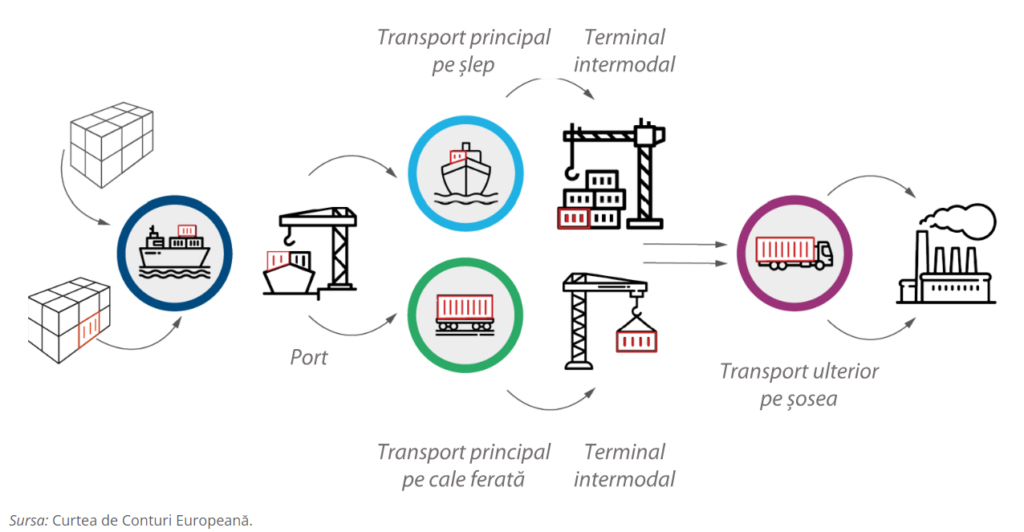
Intermodal freight transport consists of transporting goods in a single loading unit (such as a container) using a combination of transport modes: road, rail, waterways or air. This method can optimise the relative strengths of each of the transport modes in terms of flexibility, speed, cost and environmental performance.
Example of an intermodal freight transport logistics chain
What are the advantages of intermodal transport?
Combining more efficient modes of transport (rail or sea) over long distances with road transport over short distances can significantly reduce transport costs. For example, rail or sea transport is often cheaper than road transport for long distances.
Rail and sea transport are considered more environmentally friendly because they use less fuel per tonne of goods transported and produce fewer greenhouse gas emissions than road or air transport.
Loading goods into standardised containers allows for faster and more efficient handling when transferring between transport modes. It also reduces the risk of damage or theft, as the goods are not handled directly.
Using multiple modes of transport allows access to remote areas where one mode may not be viable on its own. For example, trains cannot reach everywhere, but road transport can make the last mile of delivery.
Rail and sea transport can avoid congestion on roadways, leading to more predictable and sometimes shorter transit times for certain international routes.
Secure containers reduce the risk of theft or damage. In addition, rail and sea transport involve fewer accidents compared to road transport.
Piggyback, fishyback, birdyback – types of intermodal transport
Piggyback, fishyback and birdyback are intermodal transport concepts that describe how one type of vehicle or container is transported using another mode of transport, each with specific characteristics.
Piggyback is rail-road transport, which involves the use of rail and road vehicles in a single supply chain. In this system, a truck with a trailer or semi-trailer, or the trailer itself, will be attached to a pre-established rail transport by installing an interchangeable body at a designated location.
Advantages of piggyback transport
Piggyback transport has a number of very important advantages, which make it increasingly used, especially in international logistics operations. Their main advantage is the reduction of costs for long distances, given that rail transport is generally much cheaper than road transport, avoiding road traffic congestion and contributing to the reduction of pollution.
In the case of “fishyback” transport, goods are transported in containers or trucks that are loaded onto a ship to be transported by sea. The goods are then unloaded and transported to the final destination by road or rail.
This type of transport is efficient for long distances and large quantities of goods, and involves relatively low costs.
Birdyback involves the use of aircraft to transport goods over long distances. Containers or trucks are loaded onto cargo planes for part of the route and then transported by road or rail from the airport to the final destination.
Delivery time is very fast in this case, therefore it is ideal for perishable goods or with fast delivery requirements and for international transport over very long distances.
What are the costs of intermodal transport?
Road transport is the most flexible mode of freight transport, as it ensures the movement of goods “from door to door”. For many types of goods, it is often the fastest and cheapest way to ship, even over long distances. On average, and in the absence of support measures, intermodal freight transport is 56% more expensive than the road-only alternative.
In contrast to road transport, other modes of transport, such as rail or inland waterways, are slower and less flexible. They also require specific infrastructure, which cannot be replicated at every shipping location. However, one advantage of these modes is that they offer greater safety and better environmental performance and can reduce pressure on congested roads. Intermodality means capitalising on the relative strengths of different modes of transport.
Cost comparison between intermodal freight transport and road-only transport
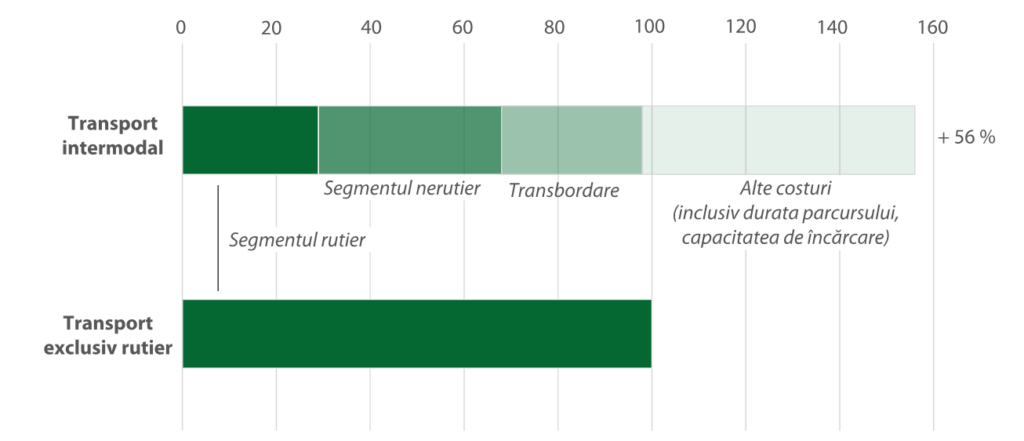
Notă: Calculul costurilor transportului intermodal se bazează pe un parcurs feroviar/rutier mediu spre lung.
Source: European Court of Auditors, based on Commission data.
Intermodal transport strategy in Romania
For the period 2014-2020, the European Union has committed a total funding of approximately 1.1 billion euros for projects supporting intermodality. Romania has an intermodal transport strategy, the specific objectives of which are to modernise and/or build intermodal terminals and related infrastructure; to provide quality intermodal services; to implement a system for tracking, planning and managing intermodal freight transport, using intelligent transport systems available on the market; and to stimulate the promotion of the national intermodal transport system.
A competitive intermodal transport system in Romania depends in the short term mainly on the modernisation and/or construction of efficient terminals in the main locations in Romania corresponding to economic development poles and freight traffic. In order to increase logistical efficiency, consideration is being given to locating an intermodal terminal in the vicinity of an industrial park. This is a measure that requires urgent investigation in the immediate future, as the concept is proving to have significant beneficial effects in Western Europe.

