

CEE Retail Marketbeat Q2 2026
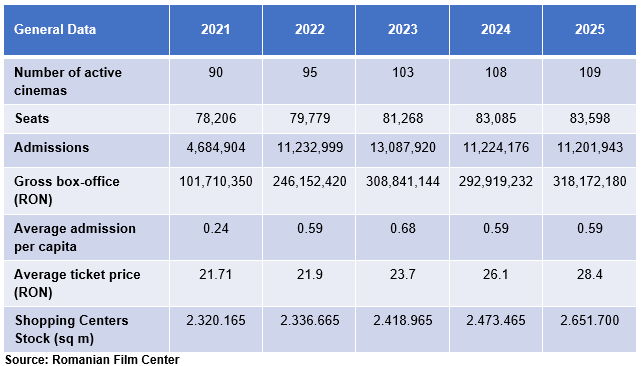
Bucharest, June 2026: Romanians spent approximately EUR 63 million in cinemas last year, a record level for the local market, reflecting an almost 7% increase compared with 2024, while the number of admissions remained relatively stable at 11.2 million, according to data from the Romanian Film Center analyzed by Cushman & Wakefield Echinox.
As a result, the total revenues generated by cinema operators reached RON 318.2 million (EUR 63 million) in 2025, compared with RON 293 million (EUR 59 million) in the previous year, mainly driven by an increase of the average ticket price, which rose to RON 28.4 (+8.8% year-on-year).
The total number of admissions stood at 11.2 million in 2025, in line with the previous year, indicating a stabilization of consumption following the peak recorded in 2023.
The average admission level remained at 0.59 visits per capita, similar to recent years, highlighting a still relatively low level compared with developed markets, but also pointing to medium and long – term growth potential.
Moreover, the cinema infrastructure continued to expand moderately, with Romania reaching 109 active cinemas and more than 83,500 seats, the majority located in modern shopping centers.
Multiplex cinemas generate over 96% of total revenues and account for 93% of total admissions, further consolidating their dominant position within the industry.
This evolution is supported by the ongoing development of retail schemes, with the nationwide shopping center stock exceeding 2.65 million sq. m at the end of 2025, which directly contributes to the performance of cinemas located within these projects.
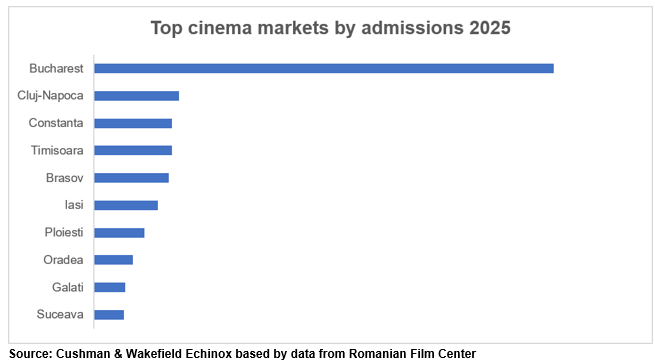
Bucharest remains the leading market, with approximately 3.4 million admissions across its 11 multiplex cinemas, followed by Cluj – Napoca with around 630,000 admissions and two cinemas, Constanta with 578,000 admissions and two multiplex cinemas, Timisoara with 574,000 admissions and three cinemas, and Brasov with 550,000 admissions and two cinemas.
These cities account for over 20% of the national multiplex cinema network and 50% of total demand, confirming the strong urban concentration of cinema consumption.
The Romanian cinema market continues to consolidate, with a structure dominated by large operators and shopping centers, while the revenue growth indicates a shift towards premium experiences and higher values per visit.
At a broader level, Romania’s cultural and recreational sector is recording solid growth, supporting the
positive cinema market outlook. The volume of activities related to entertainment, culture and recreation, alongside household repairs and other personal services, increased by 11.6% in the first quarter of this year, accounting for 2.8% of GDP.
 Dana Radoveneanu, Head of Retail Agency, Cushman & Wakefield Echinox: “The Romanian cinema market is going through a consolidation phase, where revenue growth is no longer driven by volume, but by the experience value delivered to consumers. Although the number of spectators has stabilized, the growing interest in diversified content, including local productions, as well as the integration of cinemas within modern shopping center ecosystems, are contributing to the industry consolidation. Looking ahead, we notice development opportunities in regional cities and in premium formats that can increase attendance frequency over the medium term.”
An important trend is the rising popularity of Romanian films, which reached a 23.4% share of total admissions for premieres in 2025, marking a significant increase compared with previous years.
At the same time, American productions continue to dominate the box office (more than 58% of total admissions), although their share has declined compared with the 2021 – 2023 period.