

Bucharest Flex Office Overview 2026
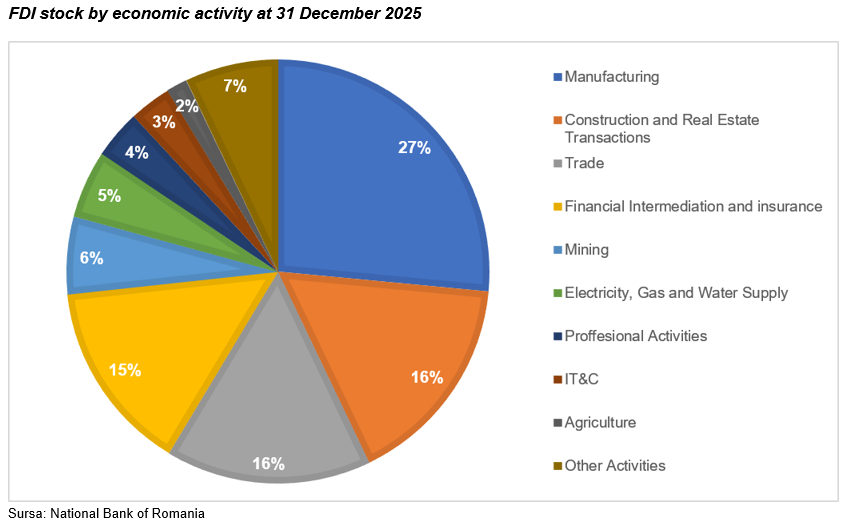
Bucharest, October 2026: The foreign direct investment (FDI) stock in the real estate transactions sector reached approximately €22.1 billion at the end of 2025. The sector thus accounts for 16.4% of Romania’s total FDI stock, compared with 16% in 2024, making it the second-largest destination for foreign capital after manufacturing (€35.7 billion and a 26.5% share), according to data from the National Bank of Romania analyzed by Cushman & Wakefield Echinox.
Real estate transactions attracted net foreign direct investment inflows of €479 million in 2025, compared with €593 million in 2024.
Separately, the construction sector attracted net FDI inflows of €74 million, with its stock reaching €1.82 billion.
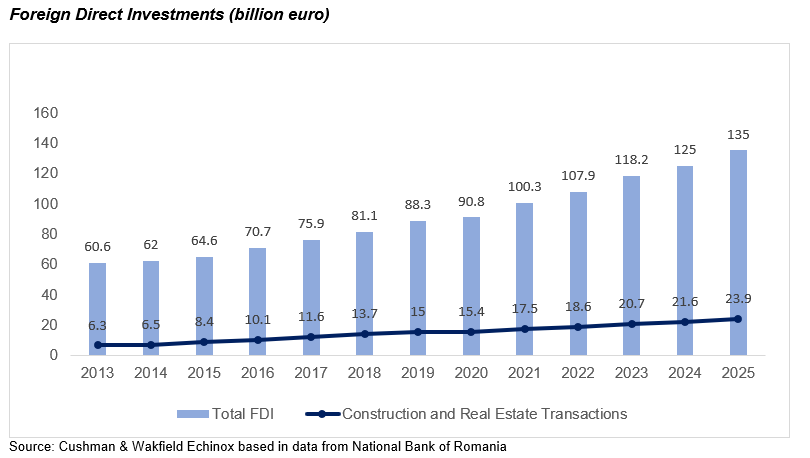
Over the past ten years, construction and real estate transactions have been among the sectors recording the strongest growth in foreign capital. Between 2015 and 2025, the FDI stock in this sector increased by 185.7%, or approximately €15.5 billion, from €8.4 billion to almost €23.9 billion. The sector’s share of the total FDI stock increased by 4.8 percentage points over the same period.
As such, construction and real estate transactions represent the second-largest sector for foreign capital in Romania, after industry, which accounts for 37.8% of the total FDI stock. Trade ranks next, with a 15.8% share, followed by financial intermediation and insurance, with 14.8%. Together, these four sectors account for 86.2% of the total net foreign direct investment stock.
Net foreign direct investment inflows into construction and real estate transactions remained positive in 2025, reaching €553 million, compared with €627 million in the previous year, corresponding to an 11.8% decrease. Nevertheless, the sector remained fourth place among economic activities in terms of net FDI inflows.
Regarding components of FDI flows, construction and real estate transactions attracted €475 million in equity investment and €316 million through debt instruments.
 Claudia Scarlat, Deputy Head of Valuation & Consulting, Cushman & Wakefield Echinox: “FDI trends confirm the important role that real estate plays in Romania’s economy. The fact that the FDI stock in construction and real estate transactions has almost tripled over the past decade, while real estate transactions alone represent the second-largest sectoral destination for foreign capital, reflects the maturation of the local market and the investors’ long-term interest in Romania. Annual inflows may vary depending on the economic environment and investment cycles, but the consistent growth of the FDI stock indicates the continued accumulation of foreign capital in the sector and highlights the further potential of the Romanian market.”
The net foreign direct investment inflows attracted by Romania reached €7.9 billion in 2025, up 41.1% compared with 2024, reversing the downward trend recorded over the previous two years. This represents the third-highest level recorded during the past decade.
The increase was mainly supported by equity investment, which reached €3.25 billion, more than double the 2024 level and the highest value recorded over the past decade. Reinvested earnings totaled €3.01 billion, while debt instruments amounted to €1.65 billion.
At the end of 2025, Romania’s total net FDI stock reached €134.8 billion, up 7.8% compared with 2024. Equity, including accumulated reinvested earnings, amounted to €98.16 billion (72.8% share), while debt instruments totaled €36.66 billion.
Over the past decade, Romania’s total FDI stock has more than doubled, from €64.7 billion in 2015 to €134.8 billion in 2025, corresponding to an increase of 108.5%. The FDI stock-to-GDP ratio stood at 35.5% at the end of last year.
The geographical concentration of foreign capital remains high. The Bucharest-Ilfov region accounts for 66.9% of Romania’s total FDI stock, up from 65.4% in 2024. From a real estate perspective, Bucharest-Ilfov also accounts for almost 63% of Romania’s modern office, retail, industrial and logistics stock.
This evolution reconfirms Bucharest’s dominant role in attracting international capital, while at the same time highlighting the potential for a more balanced distribution of foreign investment towards Romania’s main regional economic centers.
At national level, net FDI inflows stood at €415 per capita in 2025, up 41.2% compared with 2024, while the ratio of FDI flows to GDP increased from 1.6% to 2.1%.
Foreign direct investment includes the paid-up capital and the reserves related to a non-resident investor holding at least 10% of the voting power or of the subscribed share capital of a resident enterprise, debt instruments between the investor or the group to which the investor belongs and the resident direct investment enterprise, as well as the reinvestment of earnings.