
Marketbeat Romania Retail Q3 2026
Bucharest, November 2026: Small and medium-sized cities offer significant expansion opportunities on the Romanian retail market, as only ~20% of the country’s modern retail stock is located in cities with fewer than 100,000 inhabitants, according to an analysis performed by the Cushman & Wakefield Echinox real estate consultancy company.
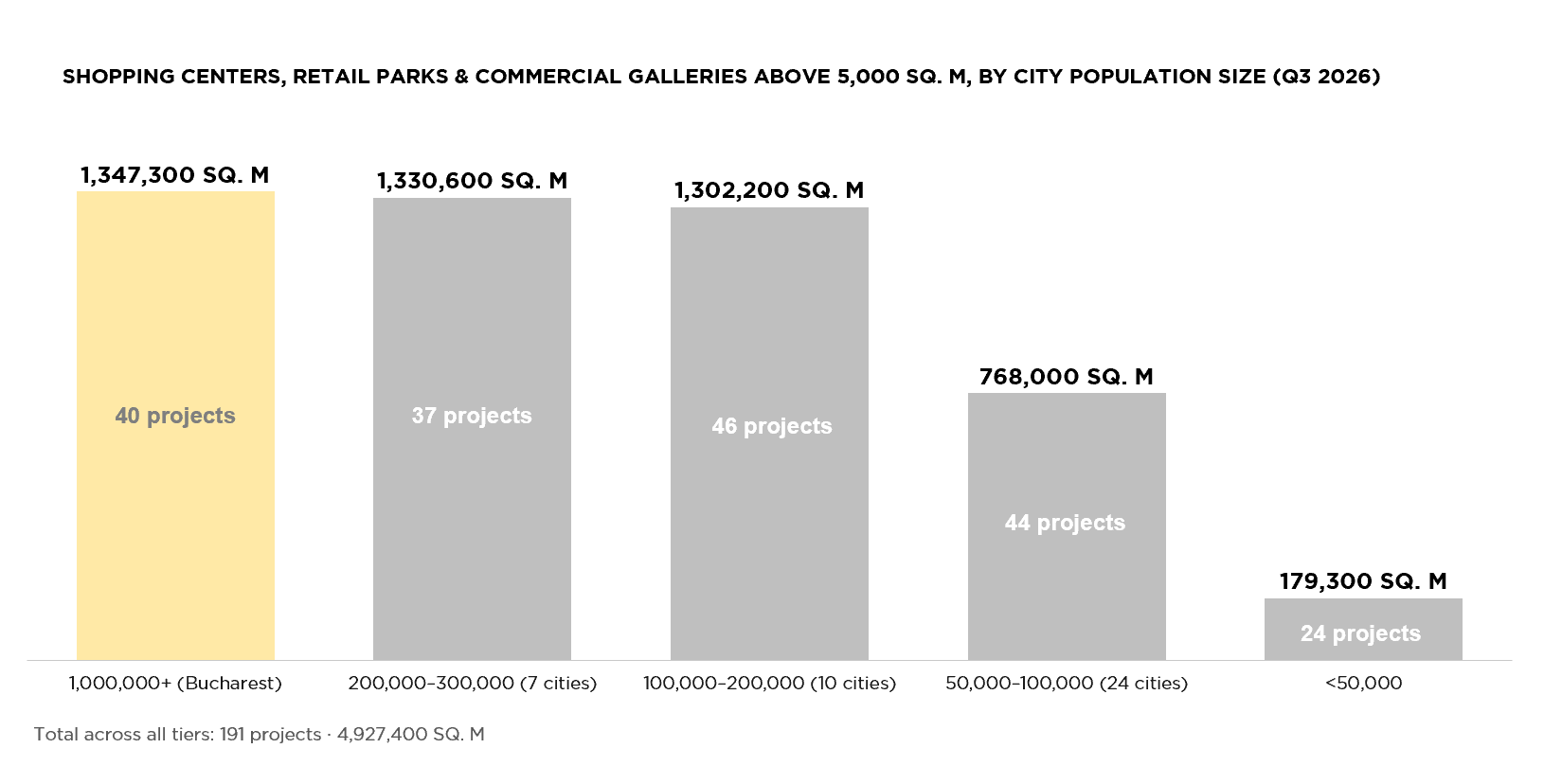
Nationwide, the modern retail stock reached approximately 4.93 million sq. m across 191 projects exceeding 5,000 sq. m, including shopping centers, retail parks and commercial galleries.
The geographical distribution of these spaces highlights a market in which Bucharest and the major regional cities account for the largest share of the existing stock, while also revealing opportunities for further expansion into smaller urban markets, where the supply of modern retail spaces remains limited.
Bucharest accounts for approximately 1.35 million sq. m of such spaces across 40 projects, representing 27% of the national stock. A comparable volume of 1.33 million sq. m is concentrated in the seven cities with populations between 200,000 and 300,000 inhabitants, while a further ten cities with populations between 100,000 and 200,000 inhabitants account for 1.30 million sq. m.
Combined, the 18 cities with more than 100,000 inhabitants have a share exceeding 80% of Romania’s modern retail stock.
In comparison, the 24 cities with populations between 50,000 and 100,000 inhabitants have approximately 768,000 sq. m of modern retail spaces, representing 16% of the national total, while cities with less than 50,000 inhabitants account for only 179,300 sq. m, or 3.6% of the country’s stock.
These differences point to opportunities for developers and retailers to expand into markets with relatively limited modern retail provision, depending on local consumer demand and the specific characteristics of each location.
 Dana Radoveneanu, Head of Retail Agency, Cushman & Wakefield Echinox: “Romania’s retail market will enter its next growth phase shaped not just by how much new space is delivered, but by where it is built and how well it meets local demand. Smaller and medium-sized cities give retailers room to expand their networks and reach new customers, yet a project’s success will rely more and more on local purchasing power, accessibility and a tenant mix tailored to community needs. We anticipate that developers will become increasingly selective, with correct project sizing and strong commercial positioning playing an essential role.”
The market’s development prospects are supported by a substantial pipeline of projects scheduled in the coming years.
According to the Romania Marketbeat Retail Q3 2026 report, almost 70,000 sq. m of new projects were delivered during the first nine months of the year. The pace of completion slowed down in the third quarter, when only two retail parks totaling approximately 11,000 sq. m were finalized.
Nationwide, more than 500,000 sq. m of retail spaces are currently under construction or in various planning stages, with completion expected by 2029.
This volume reflects continued developer interest in the Romanian market, at a time when site selection and the ability to adapt projects to local market conditions are becoming increasingly important.
During the first nine months of 2026, retail property transactions totaled approximately €375 million, representing nearly 67% of Romania’s investment volume of income-producing real estate assets.
One of the most significant transactions completed in the third quarter was AFI Europe’s acquisition of a six-property portfolio from MAS RE – Prime Kapital for approximately €281.8 million.
The portfolio (125,500 sq. m GLA) comprises of Prahova Value Centre, Zalau Value Centre, Baia Mare Value Centre, Roman Value Centre, Sepsi Value Centre and Barlad Value Centre. The geographical distribution of these properties highlights the presence of significant retail assets beyond the country’s largest regional centers.
Romania’s retail property market continues to develop against a macroeconomic backdrop characterized by weaker consumer spending and persistent inflationary pressures.
In the third quarter, Romania’s economy contracted by 0.8% year-on-year, inflation stood at 6.8%, while retail sales declined by 3.9% compared with the corresponding period of last year.
Nevertheless, prime rents remained broadly stable during the third quarter, in line with the levels recorded in previous periods.
In Bucharest, the benchmark rent for high-street retail units on Calea Victoriei and in the major shopping centers stood at €90/sq. m/month. In the main regional cities, rents for 100–200 sq. m ground-floor retail units from dominant shopping centers ranged between €50 and €65/sq. m/month.